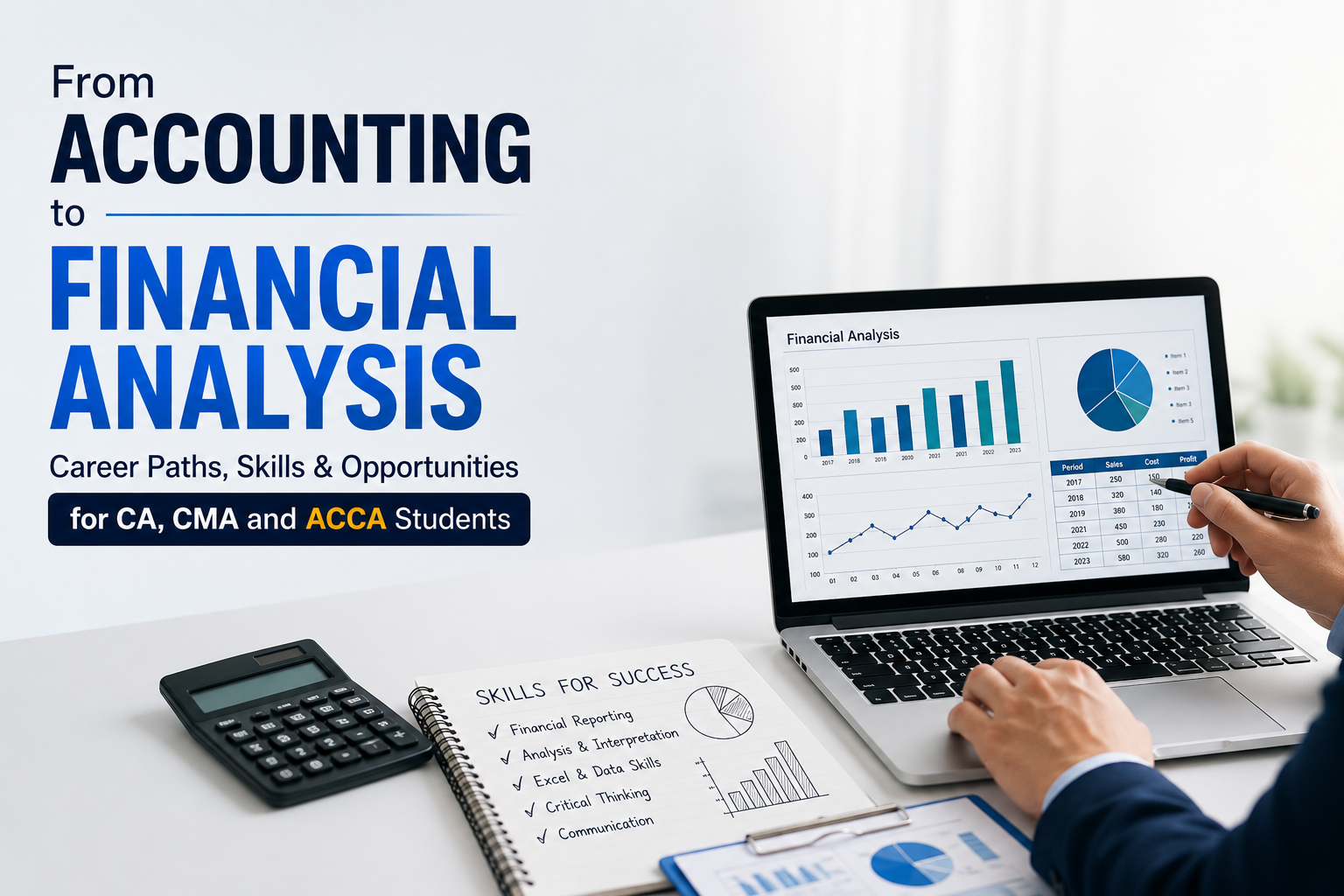
Accounting careers aren’t tied to a single country anymore. The global accounting environment and business owners are hiring finance professionals who bring both solid technical grounding and credentials that hold weight internationally. Maybe you’re aiming for a role at a multinational, hoping to break into a top audit firm, or planning to build your career abroad — either way, the certification you choose can make or break how far you get. That’s where qualifications like ACCA, CA, and CMA become relevant, in addition to a bachelor’s degree and other accounting courses.. Each one sharpens a different set of skills and opens different doors, which is exactly why employers take them seriously. This guide walks through what each certification actually offers, how they stack up against one another, and which one might fit where you want to go.
Why Professional Certifications Make the Real Difference in Finance Careers
A bachelor’s degree in commerce is a starting point, not a destination. It tells a recruiter that you have studied accounting concepts. A professional certification tells them you have been tested — repeatedly, rigorously, and under exam conditions that mirror real workplace pressure — and that an independent professional body is willing to put its name behind your competence.
This is also why professional certifications carry weight across borders in a way that university degrees often do not. A commerce degree from one country may not transfer neatly to another. A CA, CMA, or ACCA qualification, by contrast, is recognised by name in boardrooms, audit firms, and finance departments around the world, because the syllabus, the exam standards, and the ethics requirements are set centrally and applied everywhere the same way.
Before picking a course, it helps to understand what each one is actually built for. CA is built for audit, taxation, and statutory compliance within India. CMA — in both its Indian and American forms — is built for internal financial management, budgeting, and strategic decision-making inside a company. ACCA is built to be a globally portable qualification from day one, recognised the same way in London as it is in Kochi or Dubai. None of these is objectively “better” than the others. They are built for different rooms in the same building.
How to Choose the Right Course for You
Common accounting certifications like B.Com and other degrees are still relevant, but if you want to start a global accounting career, you need to be part of professional accounting certifications like CA, CMA, ACCA, and more. A degree gets your foot in the door — these certifications are what actually decide how far you go.
Chartered Accountancy (CA)
CA is run by the Institute of Chartered Accountants of India (ICAI), and it’s still the most respected accounting qualification in the country. It produces auditors, tax consultants, and financial controllers who know Indian company law, taxation, and audit rules inside out. There are three stages — Foundation, Intermediate, and Final — plus a compulsory articleship where you train under a practising CA, spending years working on real audits and tax filings before you even qualify.
It’s a hard road. Pass rates are low at every level, and the articleship tests your patience over several years. But if you want to run your own practice in India, land a spot at a Big 4 firm, or become a CFO one day, nothing else quite gets you there. CA plus ACCA is also becoming a popular combo — a qualified CA can turn their years of training into one of the strongest credential pairings around.
CMA India
CMA India comes from the Institute of Cost Accountants of India (ICMAI), and it focuses on cost control, budgeting, management accounting, and strategy — the internal side of finance rather than the audit-and-compliance side CA covers. Like CA, it runs through three stages, and you can start right after Class 12 or enter directly after graduation, with rigorous exams paired with practical training.
This one suits people drawn to the strategic, decision-making side of finance more than pure audit work. Cost accountants are in demand at manufacturing companies, PSUs, and large corporates that need help controlling costs and setting pricing, and the course is also cheaper than most alternatives — a solid starting point for students building a finance career from scratch.
CMA USA
CMA USA comes from the Institute of Management Accountants (IMA), and it’s one of the most recognised credentials in management accounting worldwide. Unlike CMA India, it isn’t tied to one country — the same exam is taken by candidates in the US, the Middle East, India, and elsewhere. It’s also short compared to CA or CMA India — just two parts, covering financial planning and performance, then strategic financial management, each mixing multiple-choice questions with case-based sections.
Pass rates run around 45-50% per part globally, so it’s tough but doable — most focused candidates finish in six months to a year. That short timeline, plus strong global recognition, is why so many Indian commerce graduates choose CMA USA over CA’s longer path, often moving into roles like financial analyst, FP&A manager, controller, and eventually CFO.
ACCA
The Association of Chartered Certified Accountants (ACCA), based in the UK, is probably the closest thing accounting has to a truly global qualification. With members in over 180 countries. The full qualification has thirteen papers across three levels, plus an Ethics module and a practical experience requirement.
What makes it attractive to Indian students is the exemption structure — a qualified CA can skip up to nine papers and clear just the four Strategic Professional papers, picking up a global qualification in as little as twelve to eighteen months. Since the syllabus covers international financial reporting and cross-border tax rules rather than any one country’s laws, ACCA-qualified professionals fit well at multinational corporations, Big 4 firms, and shared-service centres worldwide.
Why Choose Capitus for Your Professional Accounting Course?
Choosing the right institute is just as important as selecting the right professional qualification. At Capitus Global Business School, students receive industry-focused training designed to help them succeed in globally recognised accounting certifications such as ACCA, CMA USA, CMA India, and other finance programmes.
- Industry-Experienced Faculty
- Career-Focused Learning
- Personalised Student Support
- Practical and Exam-Oriented Training
- Global Career Opportunities
- Placement & Career Guidance
Conclusion
Building a successful global accounting career starts with choosing the right professional qualification. Whether your goal is to become an auditor, management accountant, financial analyst, or finance leader, certifications like CA, CMA India, CMA USA, and ACCA provide specialised knowledge and globally recognised credentials that can accelerate your career. Equally important is choosing the right learning partner. With experienced faculty, industry-oriented training, personalised mentorship, and career-focused support, Capitus Global Business School helps students gain the skills, confidence, and professional qualifications needed to succeed in today’s competitive global finance industry. If you’re ready to take the next step towards an international accounting career, Capitus can help you turn your ambitions into reality