Lorem ipsum dolor sit amet, consectetur adipiscing elit, sed do eiusmod tempor incididunt ut labore

CMA USA Jobs in India: Roles, Skills and Career Opportunities
CMA USA Jobs in India are becoming an important career option for…


CMA USA Jobs in India are becoming an important career option for…
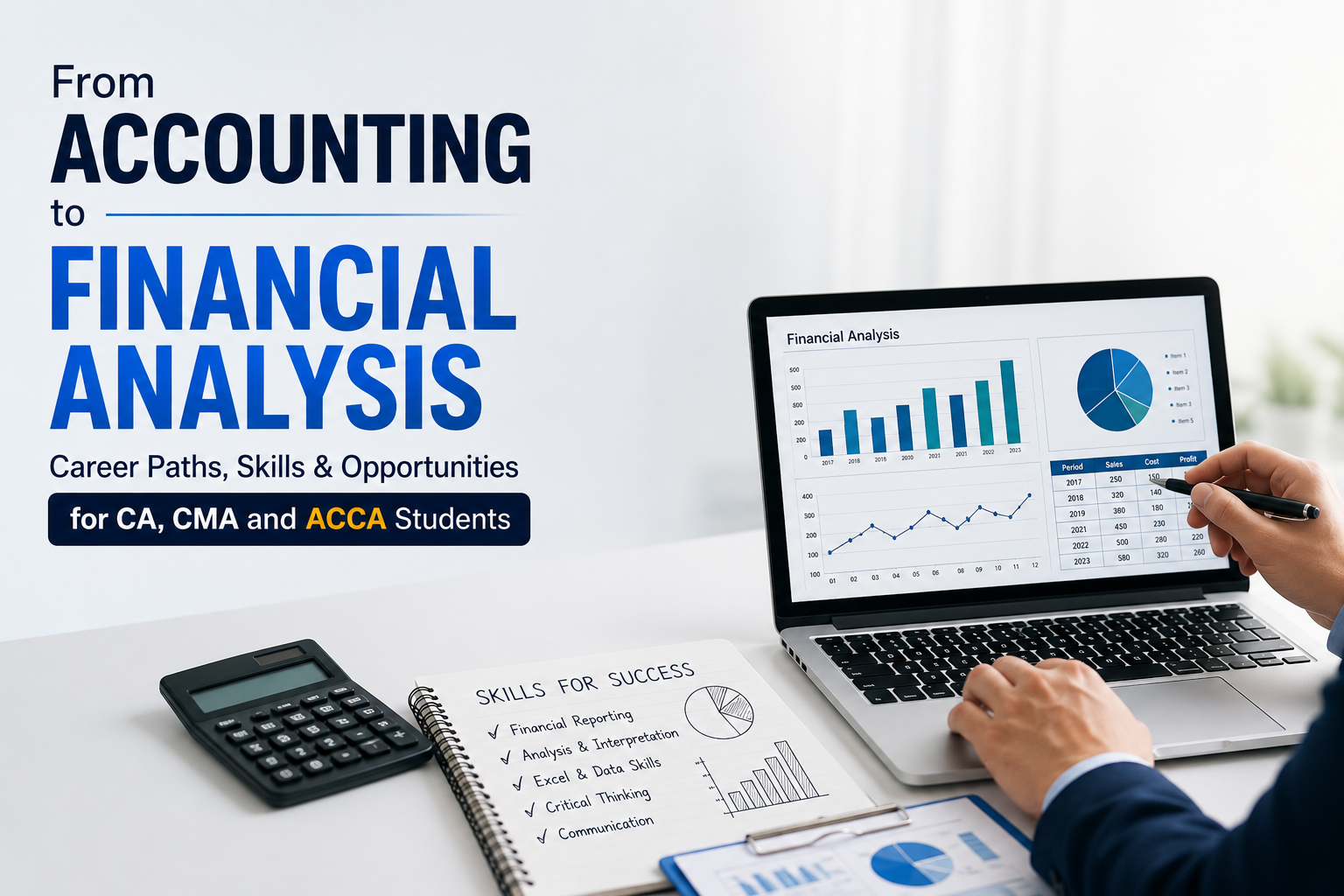
When students choose a CA, CMA, or ACCA, accounting or accountant is…

The prestigious CMA USA certification, awarded by the Institute of Management Accountants…
Lorem ipsum dolor sit amet, consectetur adipiscing elit, sed do eiusmod tempor incididunt ut labore
When students choose a CA, CMA, or ACCA, accounting or accountant is usually one of the main career options they have in mind. But these qualifications can also lead to a number of other jobs in finance. With the right skills, you can step into roles that the modern business world is increasingly demanding, such as financial analyst, FP&A executive, business analyst, or finance manager.
Accounting and financial analysis are closely related. Your accounting knowledge helps you understand financial statements, costs, profits, and cash flows. Financial analysis takes this knowledge a step further by using financial data to understand business performance and support better decisions.
This article walks through what a financial analyst actually does, how that role differs from traditional accounting jobs, and what a student pursuing CA, CMA, or ACCA needs to add to their toolkit to make that move.
A financial analyst studies financial data to understand how a business is performing. They review sales, costs, profits, and other financial information to find trends and provide insights that help businesses make better decisions.
In simple words: An accountant keeps track of financial transactions and prepares accurate financial statements, while a financial analyst studies those figures to identify trends, assess performance, and understand the company’s financial position.
That’s the core difference. Financial analysis isn’t a separate skill from accounting so much as it’s the next step after accounting. A financial analyst typically works on:
● Analysing financial statements to understand performance, not just report it
● Studying revenue, costs, profit margins, and cash flow trends
● Comparing actual results against budgets and explaining the gaps
● Preparing forecasts for upcoming months or years
● Building financial models to test different business scenarios
● Spotting patterns and trends across departments or product lines
● Evaluating whether a business decision (a new product, a price change, an expansion) makes financial sense
● Presenting findings to managers in a way that helps them decide what to do next
Accounting and financial analysis are closely connected, but they have different roles. Accountants mainly deal with financial records, transactions, reports, and making sure the numbers are correct. Financial analysts take those numbers and look deeper into them to understand how the business is performing.
For example, an analyst may compare sales and expenses, study profit trends, check where the company is losing money, or find areas where the business can improve. Their main goal is to turn financial information into useful insights that can help a company plan and make better decisions.
Since both roles work with the same financial data, it helps to see the differences laid out clearly.
Yes — and accounting is genuinely one of the stronger backgrounds for this transition, because financial analysts need to be fluent in reading
financial statements, something accounting students already spend years practising.
Studying for CA, CMA, or ACCA typically builds strong foundations in:
● Reading and interpreting profit and loss statements and balance sheets
● Understanding cash flow and working capital
● Applying accounting principles and standards
● Cost concepts and how they behave
● Recognising how business transactions flow through financial statements.
A realistic (not guaranteed) progression often looks something like this:
Junior Accountant / Accounts Executive — Learning the basics of recording transactions, reconciliations, and reporting. Heavy exposure to financial statements.
Financial Analyst / FP&A Analyst / Business Analyst — Moving from recording data to interpreting it. Building budgets, variance reports, and simple models. Working more closely with department heads.
Senior Financial Analyst — Taking ownership of forecasting cycles, more complex models, and presenting directly to senior management.
Finance Manager / FP&A Manager — Managing a small team, overseeing the budgeting and forecasting process for a business unit, and playing a bigger role in strategic decisions.
Financial Controller / Finance Director / CFO — A longer-term possibility for those who combine strong technical accounting knowledge with business and leadership skills.
This is a common route, not a fixed formula. How quickly (or whether) someone moves through these stages depends on their qualification, the industry they work in, the size of the organisation, their technical skills, and simply how their career opportunities unfold. Some people move faster by switching companies; others build deep expertise by staying within one industry for years.
Financial Statement Analysis.
This goes beyond knowing what a balance sheet is. It means being able to look at three years of statements and identify what’s actually driving the changes — is margin improvement coming from higher prices, lower costs, or a shift in product mix? This is a skill you build through repetition, not memorisation.
Advanced Excel
Excel is still the backbone of financial analysis in most companies. That means going beyond SUM and VLOOKUP into pivot tables, INDEX-MATCH, scenario analysis, and building dashboards that summarise large datasets into something readable at a glance.
Financial Modelling
A financial model is essentially a structured Excel file that links a company’s assumptions (sales growth, costs, pricing) to its projected financial statements. Companies use models to plan budgets, evaluate new projects, or test what happens if sales drop by 10%. Learning to build even a basic three-statement model is one of the highest-value skills a student can pick up.
Budgeting and Forecasting
Accounting mostly looks backward — what happened last quarter. Forecasting looks forward — what’s likely to happen next quarter, and why. Analysts need to be comfortable making reasonable assumptions and adjusting them as new information comes in.
Data Analysis
Financial analysts often work with far more data than a single set of accounts — sales data by region, cost data by department, operational metrics. Being comfortable filtering, sorting, and summarising large datasets matters more than most students expect.
Communication
Communication is the core of any job environment. An analyst frequently needs to explain a financial insight to a sales manager, an operations head, or a CEO — none of whom think in accounting terms. Being able to translate “gross margin declined 3 percentage points” into plain business language is a real, learnable skill.
Business and Commercial Understanding
Numbers don’t mean much in isolation. Understanding the industry, the competitive landscape, customer behaviour, and the company’s cost structure helps an analyst interpret figures correctly instead of just reporting them.
Problem-Solving
When a number looks unusual, an analyst doesn’t just flag it — they investigate it. That means asking the right questions, tracing the issue back to its source, and offering a reasonable explanation or recommendation.
CA, CMA, and ACCA can all be useful for building a career in financial analysis. Each qualification gives you a strong foundation in finance and accounting, but they focus on different areas. Your choice can depend on the type of finance work you enjoy and the career path you want to follow.
CA studies typically build deep knowledge in accounting, auditing, taxation, and financial reporting, along with financial management. This depth in financial reporting and compliance can be a strong asset for analyst roles that need precise, standards-based interpretation of financial data.
CMA has a particularly strong connection to management accounting, cost management, budgeting, and performance management — areas that sit very close to what FP&A and corporate finance roles actually do day to day. Students drawn to planning, budgeting, and business decision
support often find the CMA syllabus maps closely to the skills those jobs demand.
ACCA covers a broad range, from financial accounting and management accounting to financial reporting, performance management, and strategic subjects. This breadth can give students a wide foundation that’s useful across several finance career paths, not just financial analysis specifically.
Financial analysts aren’t confined to banks. You’ll find them across:
● Banks and financial services
● Investment companies
● Corporate finance departments of large companies
● Manufacturing businesses
● IT and technology companies
● Consulting firms
● Insurance companies
● Retail businesses
● Healthcare organisations
● Multinational corporations
● Startups and growing businesses
Job titles vary a lot between companies and don’t always mean exactly the same thing. Related roles you might come across include Financial Analyst, FP&A Analyst, Business Analyst, Financial Planning Analyst, Investment Analyst, Management Accountant, Corporate Finance Analyst, and Credit Analyst. It’s worth reading the actual job description rather than assuming from the title alone, since responsibilities can differ quite a bit even between similarly named roles.
A financial analyst helps a business understand what is really happening behind the numbers. For example, a company’s sales may increase by 20%, but its profit may increase by only 5%. This may look positive at first, but the analyst will try to find out why the profit did not grow as much as sales.
They may check things like:
● Higher expenses: Did the company spend more on employees, rent, technology, or other costs?
● Lower profit margins: Is the company making less profit from some products or services?
● More marketing spending: Did advertising and marketing costs increase?
● Discounts and lower prices: Did the company reduce prices to increase sales?
● Product sales: Is the company selling more products that bring in less profit?
● Supplier and inventory costs: Have the costs of materials, products, or inventory increased?
After reviewing the numbers, the analyst can explain what is affecting the company’s profit and why it is happening. They may also suggest ways to improve the situation, such as reducing unnecessary costs, reviewing prices, or finding better supplier deals.
In simple terms, a financial analyst looks at the numbers, finds the reason behind them, and helps the company decide what to do next.
A few patterns show up again and again among students trying to move from accounting into financial analysis:
● Focusing entirely on passing exams and treating everything else as optional
● Ignoring Excel because “I’ll learn it on the job”
● Avoiding internships or practical exposure until after qualifying
● Assuming the qualification alone is enough to get an analyst role
● Never actually practising how to interpret a set of financial statements beyond what’s required for exams
● Underestimating communication skills, assuming the numbers “speak for themselves”
● Applying for analyst jobs without understanding what the role actually involves day to day
● Collecting certificates without building any real, demonstrable practical skill.
None of these mistakes are fatal, but they do slow people down. The students who move fastest into analyst roles are usually the ones who start building practical skills well before they finish their exams.
Financial analysis tends to suit students who like solving problems, who enjoy digging into why numbers moved the way they did, and who don’t mind spending time in spreadsheets and financial models. If you enjoy connecting financial data to real business decisions, this path is likely to feel rewarding.
It may not be the right fit if you strongly prefer routine, well-defined tasks over open-ended investigation, or if you dislike working with data and explaining findings to others. There’s nothing wrong with preferring traditional accounting or audit work — it’s simply a different kind of day-to-day work, and knowing your own preference matters more than chasing a trendier job title.
If you are interested in exploring financial analysis along with your CA, CMA, or ACCA studies, choosing the right coaching and learning environment is also important. Good guidance can help you build a strong foundation while giving you the practical knowledge and skills needed for your future career.
Choosing CA, CMA or ACCA is not just about passing examinations—it is about building a strong foundation for a successful finance career. Modern finance careers require more than accounting knowledge. Capitus Global Business School focuses Skills such as Excel, financial modelling, forecasting, data analysis, Power BI, communication and business understanding can help students move beyond traditional accounting roles into financial analysis, FP&A, corporate finance and management positions.
For students looking for the Best CA institute in Calicut, Best CMA institute in Calicut, or Best ACCA institute in Calicut, Capitus provides a learning environment designed to connect accounting education with real-world career opportunities. Capitus focuses on practical learning along with exam preparation. The aim is to help students understand how they can use their accounting knowledge in real business situations and prepare them for different career opportunities in finance.
An accounting qualification gives you a genuinely strong starting point — the ability to read financial statements, understand cost behaviour, and follow how money moves through a business. That’s not nothing; it’s the foundation most financial analysts are built on.
But the qualification by itself is the starting line, not the finish line. Moving from accounting into financial analysis means deliberately picking up modelling, forecasting, data skills, and the ability to explain what the numbers actually mean to the people making decisions. The good news is that none of this needs to wait until after your exams are done. Start building these skills alongside your CA, CMA, or ACCA studies, and the shift from accounting to financial analysis becomes far less of a leap and far more of a natural next step.
CA, CMA, and ACCA can lead to many finance careers beyond traditional accounting. With skills like Excel, financial modelling, data analysis, Power BI, and good communication, students can explore roles in financial analysis, FP&A, corporate finance, and more.The key is to start building these practical skills while studying, rather than waiting until after completing the qualification. Choosing the right learning environment can also make a difference.
Professional accounting education with practical, career-focused learning. For students looking for the Best CA institute in Calicut, Best CMA institute in Calicut, or Best ACCA institute in Calicut, Capitus helps students build the knowledge and skills needed to explore wider career opportunities in
finance.